TECH 203: Advanced Electroacoustic Music
Spring 2026 Class Concert program
each work is for octophonic (8-channel) fixed media
Frances Salata — In The Sun
Sofia Scherer, voice
Ellie Ahmed, flute
The ancient Welsh story Math Fab Mathonwy is a dark and fantastic tale of love, betrayal, magic and death. When Llew Law Gyffes is cursed to never take a human wife, the magician Math crafts him a wife out of flowers; Blodeuwedd. You will hear the field mourning her. The flowers stay stationary in their respective places, rooted to the ground. The tin crackling magic of Math travels around the room lithe and sneaky, distorting the peace.
Laura McCafferty — HEARSEE
HEARSEEMEHEARSEEMEHEARSEEMEHEARMESEEMEHEARMEHEREHEARMESEEMEH EARSEEMEHEARSEEHEARMESEEMEHEARMECANYOUHEARMECANYOUSEEMECANYO UHEARMEHEARMEHEARMEHEARMEHEARMEHEARMEHEARMEHEARSEEHEARSEEHEA RMECANUSEEMEHEARMESEEMESEESEEHEARSEEHERESYMEHEARMEHEREHEARME SEEMECANUSEEMECANUHEARMEHEARMECANUHEARMEHEARMEORSEEMECANYOU HEARMECANYOUSEEME
HEARSEE INCLUDES INTERPOLATIONS FROM A REQUIEM FOR A DREAM SCORE. IT IS OCTOPHONIC ACOUSMATIC PRODUCTION AS A MEANS TO INDUCE EUPHORIC DISORIENTATION.
Chloe Biggs — Newark Penn Station
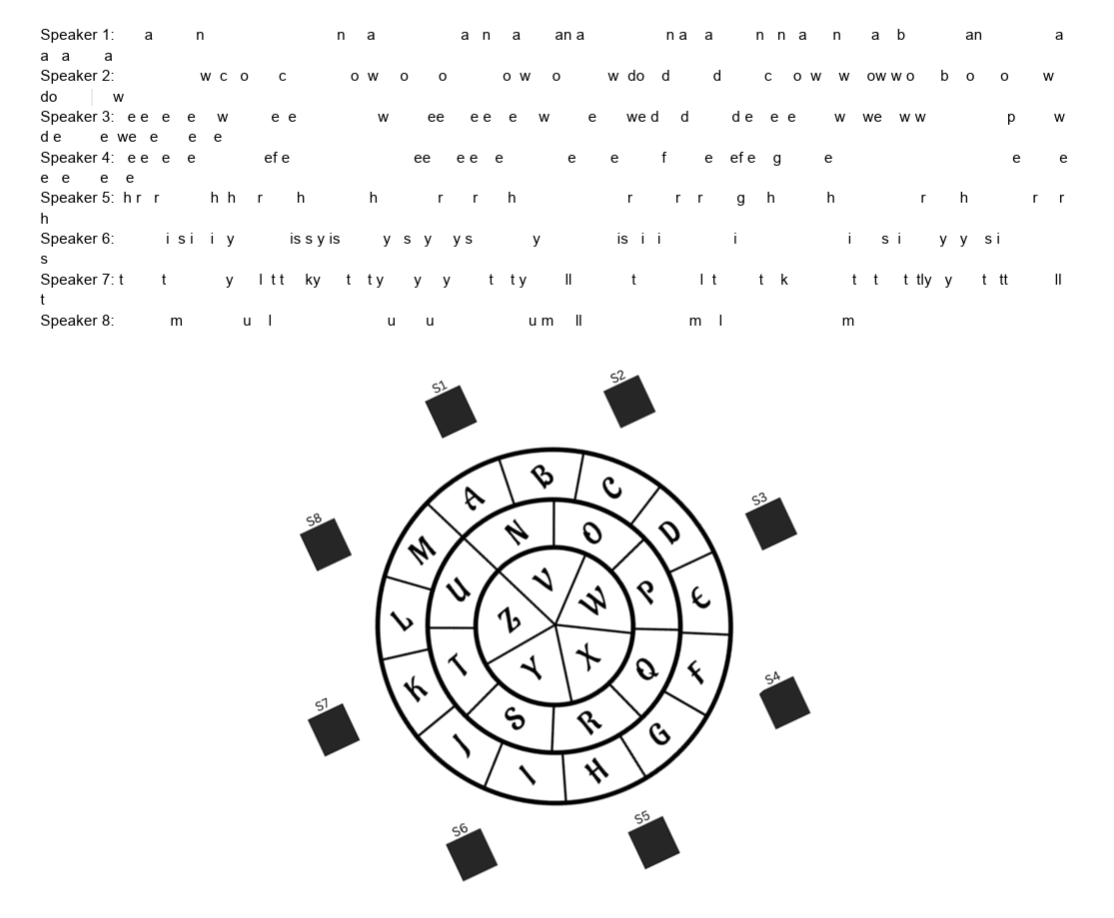
Madeleine Ward — And Yet, I Still Breathe
“And Yet, I Still Breathe” is a piece that has 3 messages occurring at the same time. One being the vocals, one being a low bell sound and one being morse code. Both the morse code and the bell sound spell out different messages by which speaker they are played in. This piece was inspired by sigils and the power we often give to shapes.
Sam Sentivan — Eighth Elegy
Who, then, has cast us in the role of one
needing to part, no matter what we do?
As one, who stands on the last hill,
sees his familiar valley one more time,
looks back, halts, lingers...
so do we live, forever taking leave.
Riley Gibbons — Notation: Date, Time, Place, Thoughts for My Dear Journal
My Piece’s text is a poem I wrote in one of my spring semester courses, Poetry Lab. Please enjoy! If you would like to read the poem, here is a link to the poem.
Ellie Ahmed — Eye of the Storm
This piece uses subtractive synthesis to simulate the sounds of a heavy thunderstorm.
Miriam Evans-Sachs — Greenleaf
Greenleaf is the middle name of Seeley Greenleaf Mudd, a well known doctor and philanthropist of the first half of the 20th century. He also happens to be the man for which Oberlin’s central library building is named (not the actual library–that would be Mary Church Terrell). For me and many more, the name Mudd has come to represent a fixture of Oberlin campus life, a layered (literally) and multifaceted community and study space towering in the center of Wilder Bowl. The architecture of the building and its interior layout have always enchanted me, and as I find myself within days of leaving this campus, maybe forever, I wanted to pay testament to it. You’ll hear the four distinct floors, often differentiated by their sound levels, represented in the song, along with many references to the building and its culture. Plus, the verses about each floor are underscored by field recordings taken in the actual spaces. Next time you walk up the great brutalist ramp and into its color-coded chambers, take a minute to appreciate this breathtaking building and all it offers our little school.
Stella Kollmansberger — We Are Infinite
Using text from “The Perks of Being a Wallflower” by Stephen Chbosky, this is a spatialized piece symbolizing what it means to be perceived as quiet, but knowing that you still have an infinite effect on others and the world around you. “We are Infinite” explores themes of surprise through its spatialization in the room, just like how Charlie (the protagonist of the story) defies the typical, cynical, or rebellious tropes of usual teenage protagonists.
Lonny Hoffman Dilloway — Untitled
Oscar Bohnenkamp — sinawi-not-recognized
Sinawi is a form of Korean folk music attributed to practices of Korean Shamanism, performed as an improvised ensemble music. Typical sinawi ensembles consist of: the janggu and buk, the two interplaying drums; the piri and daegeum, two flutes; the geomungo and gayageum, the two plucked zithers; and two “bowed” instruments, the ajaeng and haegeum. One of the most distinctive qualities of sinawi music is its diverse timbral range within the ensemble, as well as its simultaneously independent and “group-minded” instruments.
This piece takes on the general form and sound of sinawi, yet also comes off as distinctly removed or estranged from the actual practice. Instruments don’t sound quite right, electronic drums trade off in awkward cuts, as other distortions and manipulations impede on this “authentic” realization.
“Did not recognize, did not recognize, did not recognize...”